
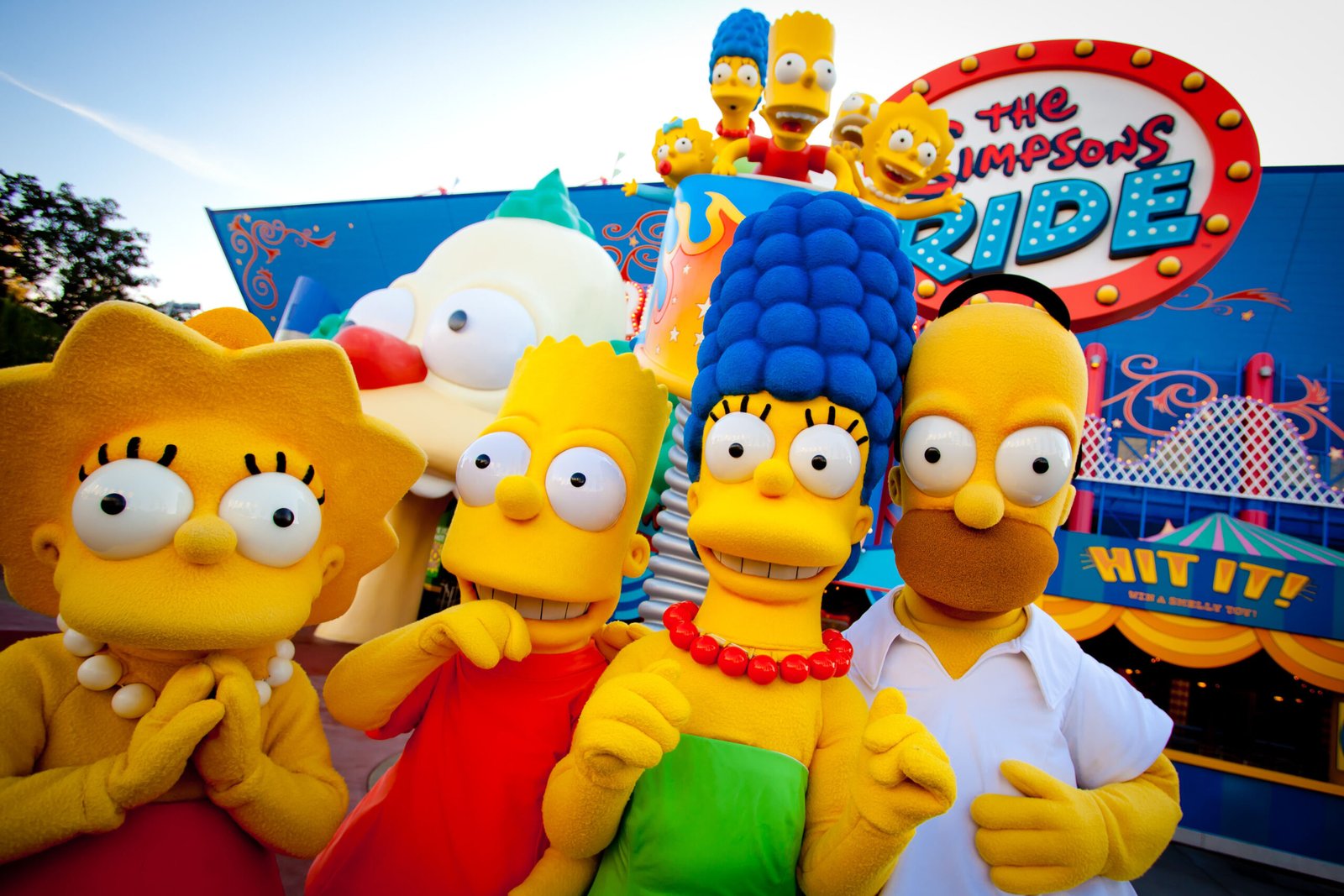
The Simpsons Ride
Opens your browser's print window, where you can also save this guide as a PDF.
Overview
The Simpsons Ride is an indoor motion simulator that sends the Simpson family, and you, on a spectacularly unsuccessful visit to Krusty the Clown’s new theme park.
You board an eight-person simulator vehicle for what is supposed to be a ride through Krustyland, before Sideshow Bob takes control and turns the experience into a chaotic journey through roller coasters, water rides and other increasingly unsafe attractions.
The vehicle itself does not travel around a track. Instead, it moves on a powerful motion base in front of an enormous curved projection screen, tilting, rising, dropping and jolting in time with the animated action.
There are no real coaster drops or inversions, but the combination of strong physical movement and a screen filling most of your field of vision can make the attraction feel much more intense than a conventional simulator.
Queue Details
The queue begins outdoors in Springfield before gradually moving inside the Krustyland attraction building.
Much of the outdoor queue is covered and includes television screens playing specially created Simpsons and Krustyland material. The area can still become hot, particularly when queues extend into the more exposed sections.
Guests using an ECV or powered mobility device need to transfer to a standard manual wheelchair before continuing through the attraction.
Manual wheelchair users can remain in their wheelchair through the queue until they reach their assigned simulator.
The final part of the experience is divided into several holding and pre-show areas. Groups are directed into smaller rooms before being assigned to an individual simulator vehicle.
These spaces can feel busy and enclosed, with animated screens, continuous dialogue, music and characters talking over one another.
There is no continuously moving loading platform. The simulator is stationary while guests board.
Transfer Info
Wheelchair users must transfer completely into the simulator vehicle.
The ride vehicle has two rows of bench-style seating with a lap restraint.
The important feature for transferring is the 10-inch / 26 cm high barrier into the ride vehicle compartment.
You need to negotiate this barrier before reaching the seat. This can be done independently or with physical assistance from somebody in your own party.
The wheelchair can be brought to the loading area so you can position it close to the simulator before transferring.
Once inside the vehicle, you need to lower yourself onto the bench seat and position your legs inside the passenger compartment.
There is no wheelchair-accessible seating within the moving simulator, so a complete transfer into the normal ride seat is required.
After everyone is seated and restrained, the simulator begins its motion sequence. Your wheelchair is returned to you when you leave the attraction.

Sensory Experience
What do these sensory tags mean?
- Enclosed Spaces
- Guests spend part of the experience in a confined or enclosed space that may feel restrictive.
- Fog/Smoke
- Theatrical fog, smoke or similar atmospheric effects are present.
- Motion Simulator
- A moving seat or platform is synchronised with filmed or projected motion.
- Sudden Movement
- The ride vehicle, seat or platform makes abrupt starts, stops, jolts or changes of direction.
- Vibration
- Noticeable shaking or vibration is deliberately transmitted through the seat, platform or vehicle.
- Water
- Guests may encounter splashes, sprays, mist or other water effects.
Sensory experiences vary between people. These tags describe elements that may be present, not how strongly any individual guest will experience them.
The Simpsons Ride is one of the more aggressive motion simulators at Universal Studios Florida.
The vehicle repeatedly tilts, rises, drops, accelerates and jolts, with abrupt changes in direction designed to match the animated ride sequence.
An enormous curved projection screen fills much of your field of vision. The combination of physical movement and rapidly moving imagery creates convincing sensations of falling from height, racing along coaster track and being thrown through Krustyland.
There are no 3D glasses.
Motion sickness can be a significant issue because the screen provides strong visual movement at the same time as the simulator moves underneath you.
The experience includes loud music, shouting, crashes, explosions and several deliberately chaotic sequences with very little quiet time between them.
There are water and fog effects, including moments where riders may feel a light spray.
The attraction also includes simulated heights and falling, despite the passenger vehicle remaining inside the show building.
The vehicle is enclosed by high sides once you are seated, and the combination of a relatively small passenger compartment and enormous screen can feel quite immersive.
The queue and pre-shows are also visually and audibly busy, with multiple screens, character voices and deliberately frantic Simpsons-style humour.
Practical Tips
The 10-inch / 26 cm barrier into the simulator is the main physical feature to consider when planning the transfer. It is a substantial step rather than a small threshold, although somebody in your own party can assist you over it.
If you need help transferring, position the wheelchair as close to the simulator as possible before starting rather than trying to bridge a larger gap.
ECV and powered-mobility-device users should expect to change to a standard manual wheelchair before entering the attraction.
If motion simulators make you nauseous, this is one to approach cautiously. The enormous screen occupies so much of your vision that closing your eyes or focusing briefly on the inside of the physical ride vehicle can reduce some of the visual-motion sensation.
Service animals can accompany guests, but this is an unusually dynamic attraction for an animal: the vehicle has abrupt multi-directional movement alongside loud noises, fog and water effects. If you are considering riding with a service animal, speak to a Team Member before boarding about the practical setup.
The pre-show is worth paying attention to rather than treating it purely as queue time — there are jokes and background details everywhere, and it sets up why trusting Krusty with the construction of an entire theme park was an exceptionally poor decision.
Krustyland appears to have been designed without engineers, planning permission or insurance. Somehow, Homer is still not the biggest safety problem.
Attraction Gallery


Spotted something we should update?
Theme parks change, and sometimes you’ll know something we don’t. If you’ve noticed something that’s changed, spotted something we’ve got wrong, or have useful information we should add, let us know.
Send us an update →