

Star Tours – The Adventures Continue
Opens your browser's print window, where you can also save this guide as a PDF.
Overview
Star Tours – The Adventures Continue is a 3D motion-simulator attraction that sends you aboard a Starspeeder 1000 for an unexpectedly eventful journey through the Star Wars galaxy.
C-3PO accidentally ends up piloting the ship, and what should have been an ordinary flight quickly turns into a chase involving familiar planets, characters and battles.
The attraction randomly combines different scenes and characters, so repeat rides can produce different journeys.
The simulator itself remains inside the building, but the entire cabin moves in sync with a large 3D screen to create the sensation of flying, accelerating, falling and being thrown around during the adventure.
Queue Details
The queue begins outdoors beneath the large AT-AT before continuing into an indoor Star Wars spaceport filled with droids, displays and moving scenery.
Wheelchair users can remain in a standard manual wheelchair throughout the accessible queue.
Guests using an ECV need to transfer to a standard manual wheelchair before continuing through the attraction.
The standard queue is step-free, but it follows a fairly long, winding route. Wheelchair users can instead use the accessible entrance to the left of the standard entrance.
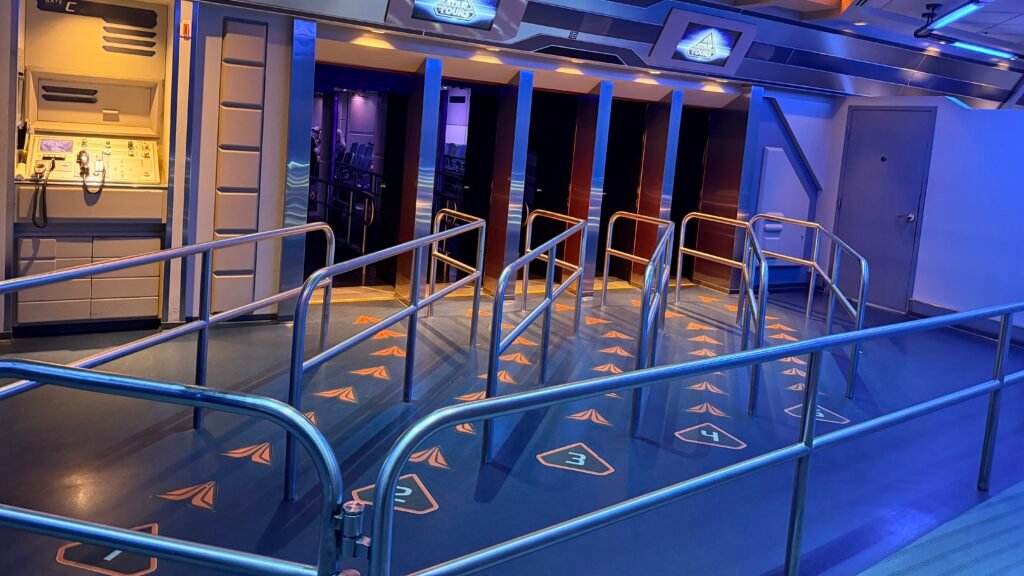
The accessible route follows an uphill ramp towards the boarding area and can provide a more straightforward route than negotiating the full standard queue.
Your wheelchair can be taken directly into the simulator cabin so it can be positioned close beside the ride seat before you transfer.
3D glasses are collected before boarding.
The exit includes a slight uphill ramp.
Transfer Info
Wheelchair and ECV users must transfer completely into a simulator seat to ride.
Guests using an ECV first need to transfer to a standard manual wheelchair before continuing through the attraction.
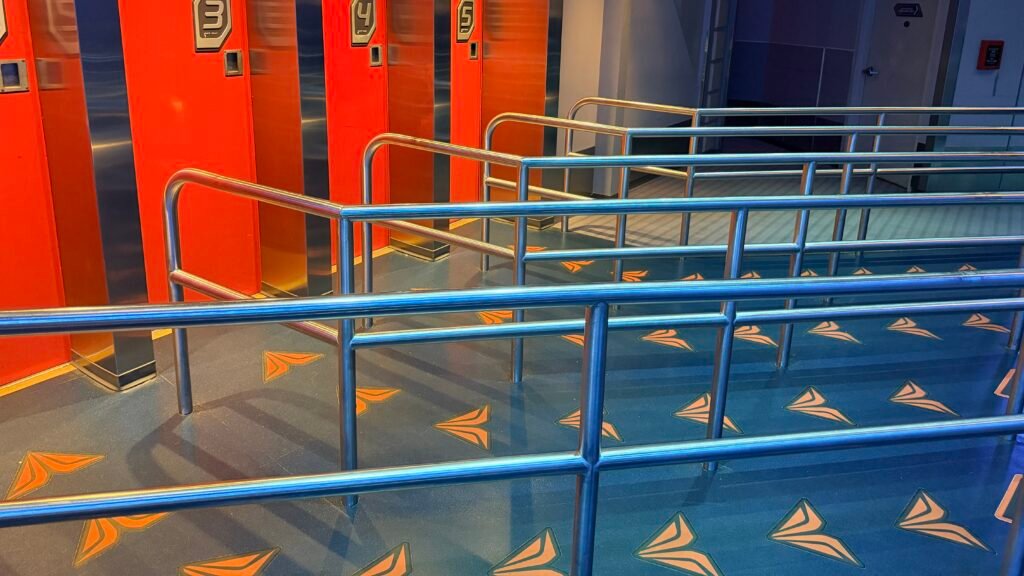
At boarding, the wheelchair can be brought inside the Starspeeder cabin and positioned immediately beside the front-row end seat.
The side of this seat swings open, creating additional space for the wheelchair to be positioned close to the seat and making a sideways or diagonal transfer easier.
There is no high vehicle wall to step over, and the simulator seat is around normal chair height.
Once seated, an individual seatbelt secures you around the waist.
Your wheelchair is removed from the cabin before the doors close and returned to you when the simulator finishes.
If physical lifting or bodily assistance is needed during the transfer, that assistance needs to come from somebody in your own party.

Sensory Experience
What do these sensory tags mean?
- 3D
- 3D glasses or stereoscopic screen effects are part of the experience.
- Flashing Lights
- Flashing, strobing or rapidly pulsing light effects are used.
- Motion Simulator
- A moving seat or platform is synchronised with filmed or projected motion.
- Sudden Movement
- The ride vehicle, seat or platform makes abrupt starts, stops, jolts or changes of direction.
- Vibration
- Noticeable shaking or vibration is deliberately transmitted through the seat, platform or vehicle.
Sensory experiences vary between people. These tags describe elements that may be present, not how strongly any individual guest will experience them.
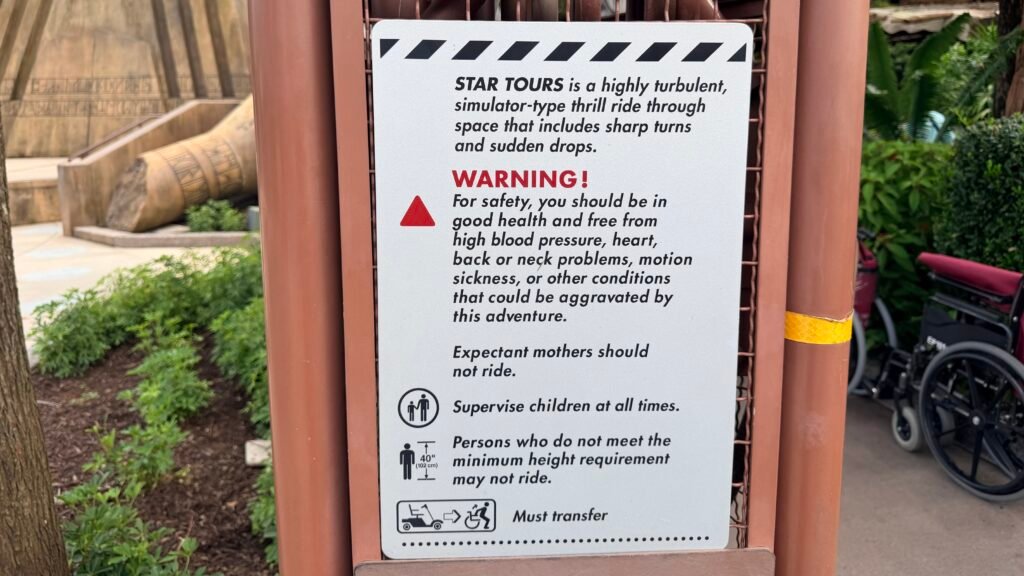
Star Tours is a motion simulator, and the physical movement is a major part of the attraction.
The entire cabin tilts, pitches and moves suddenly in several directions while the 3D imagery creates the sensation of flying at high speed.
There are simulated drops, rapid turns, collisions and sudden changes in direction.
Because the physical movement is synchronised with fast-moving 3D imagery, the sensation can feel considerably stronger than the actual movement of the simulator.
Guests wear 3D glasses throughout the flight.
The experience includes periods of darkness, flashing and rapidly changing lighting, explosions, blaster fire and loud sound effects.
Characters and vehicles can appear to travel directly towards the cabin or pass extremely close to it.
The storyline changes between rides, so the exact combination of locations, characters and effects is not completely predictable.
Motion sickness can be a significant consideration, particularly because the screen fills much of your field of vision while the cabin moves beneath you.
Practical Tips
If simulator rides cause motion sickness, removing the 3D glasses or briefly closing your eyes can reduce much of the visual motion sensation while the physical simulator continues moving.
Because Star Tours randomly combines different scenes, one ride can feel slightly different from another in both storyline and movement.
Service animals cannot ride, so ask a Cast Member about the available arrangements before joining the queue.
C-3PO has spent decades insisting that he is not designed for adventure. Disney continues to respond by putting him in charge of public transport.
Attraction Gallery
Spotted something we should update?
Theme parks change, and sometimes you’ll know something we don’t. If you’ve noticed something that’s changed, spotted something we’ve got wrong, or have useful information we should add, let us know.
Send us an update →